Showing posts with label behaviour. Show all posts

Saturday, June 4, 2011

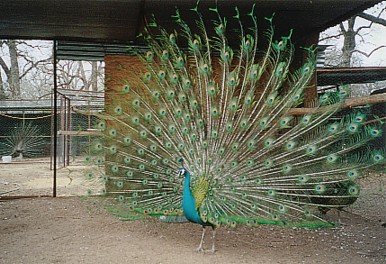
Indian Peafowl


The Indian Peafowl or Blue Peafowl (Pavo cristatus) is a large and brightly coloured bird of the pheasant family native to South Asia, but introduced and semi-feral in many other parts of the world.

Peafowl are best known for the male's extravagant display feathers which, despite actually growing from their back, are thought of as a tail. The "train" is in reality made up of the enormously elongated upper tail coverts. The tail itself is brown and short as in the peahen. The colours result from the micro-structure of the feathers and the resulting optical phenomena.

Peafowl forage on the ground in small groups, known as musters, that usually have a cock and 3 to 5 hens. After the breeding season, the flocks tend to be made up only of females and young.

Peafowl produce loud calls especially in the breeding season. They may call at night when alarmed and neighbouring birds may call in a relay like series. Nearly seven different call variants have been identified in the peacocks apart from six alarm calls that are commonly produced by both sexes.


Tuesday, November 9, 2010

Cognitive Behavioural Therapy

Cognitive Behavioural Therapy (CBT) is a form of therapy based on the idea that we make interpretations of ourselves, others and the world constantly. These interpretations or 'self-talk' are based on expectations and beliefs that we have learned from others or through our own experiences.

Our self-talk, therefore, determines how we feel. We may choose to interpret and event in a negative unhelpful way and therefore feel negative or in a more positive and helpful way and therefore feel positive.

Our self-talk also therefore impacts on our behaviour or the things we choose to do. In fact, it then becomes a cycle with the behaviour impacting on the original situation and giving us another opportunity to make an interpretation.

Negative Automatic Thoughts

Negative automatic thoughts can become habitual. The more you think negatively, the lower your mood is likely to become and if this happens then you are more likely to think negatively. It is a vicious cycle. You are constantly describing the world to yourself, giving each event or experience some label. You make interpretations of yourself, of what you see and hear. You judge events as good or bad, painful or pleasurable, and you predict whether they will bring you danger or relative safety. These labels and judgements are fashioned from the unending dialogue, which you have with yourself.